
Probably the most infamous federal prison of the US is Alcatraz but its origin had a different intent. During the Spanish rule of California, Juan Manuel de Ayala charted San Francisco Bay in 1775. He named today’s Yerba Buena Island as “La Isla de los Alcatraces”, which translates as “The Island of the Gannets” more commonly translated as “Island of Pelicans”.
The earliest recorded private owner of the island of Alcatraz is Julian Workman, to whom it was given by Mexican governor Pio Pico in June 1846, with the understanding that Workman would build a lighthouse on it.
The island was sold to the US government in 1849 and the first lighthouse on the coast of California was built there in 1854. Other buildings were erected on the island, and the first permanent army detachment was garrisoned there in 1859. In 1861 the island was designated a residence for military offenders. In 1907 the island was designated the Pacific Branch of the United States Military Prison. From 1934 to 1963 it served as a federal prison for some of the most dangerous civilian prisoners.

There is a poster when you first start your tour of the cellhouse that really sheds the current feel for the purpose of the island.
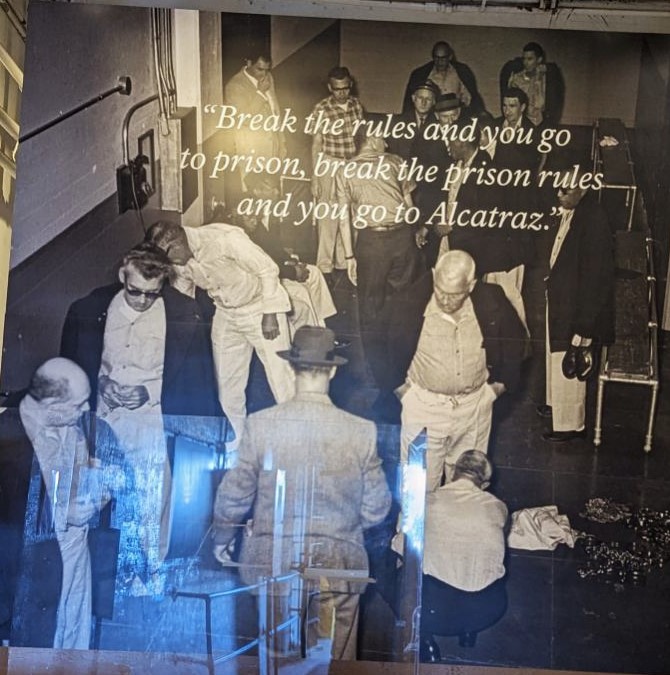
Aside from the cellhouse on top of the island, two structures stood out to me, for different reasons. One is from the movie “The Rock” where Sean Connery is walking across the shell of the Officers’ Club. I don’t have a picture of Sean Connery, but I do have a picture of the Officers’ Club where I believe the shot was taken.

The other structure that caught my eye was the water tower. Not an imposing structure by any means but its historical noteworthiness were fascinating. In November 1969 Indian activists, including members of the American Indian Movement, occupied the island again, demanding the deed to the island and refusing to leave until they were forced off by federal marshals in June 1971.


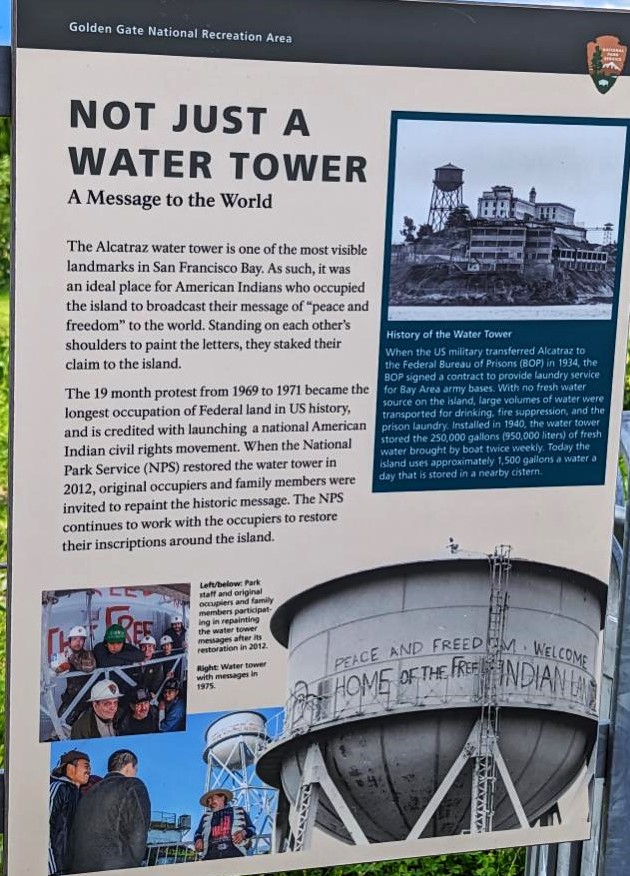
I found it interesting that family members of the original occupiers of the 19 month protest were allowed to repaint the tower in 2012 and other areas around the island, so that the history of the island had yet another chapter.
Well, there will be one more post for Alcatraz where I give my take on the cellhouse itself. I know that many others has been there and posted about what all they saw but each person sees this history from a different side. I see it with conflicting issues of history, amazement of how the notorious prisoners lived, all mixed with a heavy dose of sadness of wasted lives.
Let us never waste opportunities to be kind, showing consideration of others and reflect the power of grace offered to us from above.




 For the Love of